


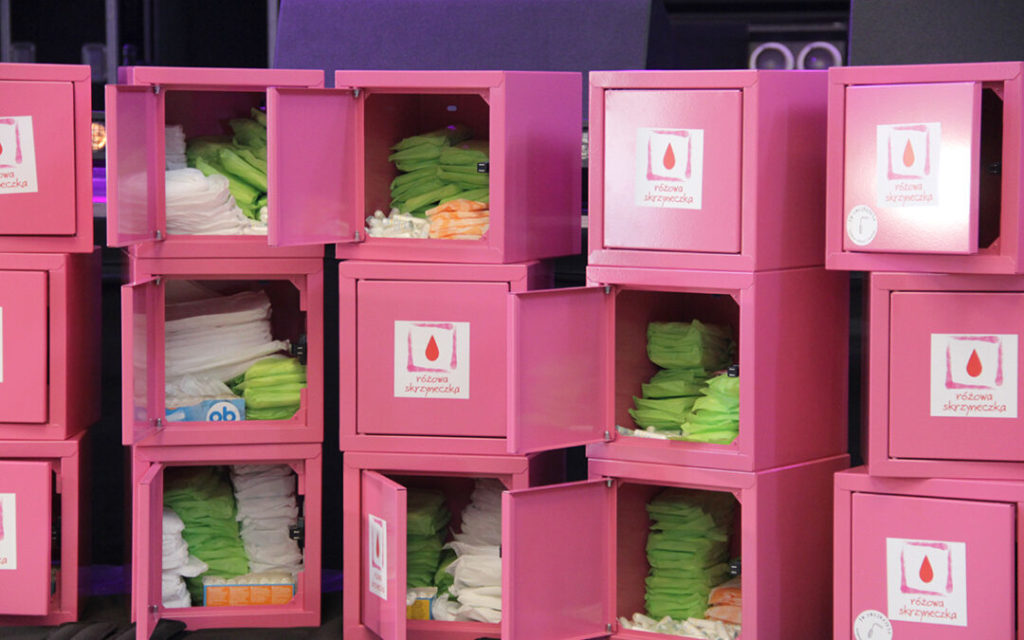
Rzeszow, a city in Poland, has recently put “Pink Boxes” in various public spaces throughout the city. These small containers provide free menstrual products to women in need, which helps with reducing the stigma surrounding menstruation. Ultimately, the initiative aims at supporting women who might suffer from period poverty.
The boxes have been used in other Polish municipalities for a few years, such as Sopot, Gdańsk and Łódź. People can usually find them in libraries, parks, public transportation hubs or at schools; at the moment, 43 schools in Rzeszow have implemented them. Inside the boxes are multiple types and sizes of hygienic products, from wipes and pads to tampons. They also contain information about menstrual health and hygiene.
The boxes can be restocked by institutions or private sponsors as well as in accordance with the project’s principle: take it if you need it, leave it if you have excess.
Period poverty is a big issue in Poland. According to a report prepared for the Kulczyk Foundation, nearly half a million people in Poland cannot afford to buy sanitary products. Furthermore, 21 percent of schoolgirls are forced to leave school due to lack of the products while 10 percent of them don’t leave their house at all during their periods.
“That is why I decided to introduce pink boxes in Rzeszów,” explained Konrad Fijołek, the mayor of Rzeszów. Overall, the Pink Boxes initiative is a positive step towards supporting women’s health and well-being in Rzeszow. It serves as an example of how small, community-led initiatives can have a big impact on people’s lives for a minimum cost – less than 600 euros in the case of the “Pink Box initiative”.
Map of Pink Box sites across Poland
The CEMR European Charter for Equality and Agenda 2030 reinforce each other.
The European Charter for Equality of Women and Men in Local Life and Agenda 2030 are two policy documents that largely have common goals and can serve as leverage for each other.
This matrix shows how the articles in the CEMR Charter are related to goals and sub-goals of Agenda 2030. This makes it easier to see how the work on the Charter contributes to the completion of the agenda and vice versa. There is also a column where the user can fill in their organization’s own gender equality and sustainability goals.
The European Charter for Equality is a tool for municipalities and regions that want to work for a society that is not only formally but also effectively equal. Similarly, Agenda 2030 is an expression of the fact that the countries of the world want to protect human rights and promote equality and the empowerment of all women and girls.
Common principles
The European Charter for Equality is based on six basic principles. Corresponding principles can be found in the introduction to Agenda 2030, where the signatories describe the purpose of the sustainability goals and how the agenda is to be implemented.
In both the CEMR Charter and Agenda 2030, gender equality is treated as a fundamental right. At the same time, it is emphasized that the rights apply to different groups of women and men, girls and boys, with reference to e.g. ethnicity, religion, socio-economics and disability.
Both the Charter and the agenda highlight an even gender distribution in all decision-making as a prerequisite for a democratic society. The gender mainstreaming strategy in the Charter corresponds to the requirement for systematic integration of the gender equality perspective in the agenda. Both the Charter and the agenda emphasize the importance of the political commitments including decisions on adequate funding.
[Originally published on: https://www.graz.at/cms/beitrag/10371270/7770531/Jahre_Gleichstellung.html]
In 2001 the go-ahead was given for the implementation of Gender Mainstreaming in the City of Graz!
Right from the start with the clear commitment of the decision-makers in politics and administration. This website features the (very) concentrated overview of 20 years of work for equality and also shows how extensively the topic is implemented in our city. Even if everything has not yet been achieved, the focus is on successes and the continuing work for Graz to get equal.
See the main achievements of 2021:
- Graz calendar of diversity goes online
- Resolution 3rd. Equality Action Plan
Anniversary folder PDF download (DE)
The printed version of the anniversary folder can be requested here: priska.pschaid@stadt.graz.at
[From https://agenda21culture.net/documents/report-9]
Cultural Actions Supporting Gender Equality in Cities and Territories
The report “Cultural Actions Supporting Gender Equality in Cities and Territories” is a contribution from the cultural perspective to address women’s rights and genderresponsive policies for sustainable development. Drawing upon data collected from UCLG archives, the experience and insights of UCLG members and partners that responded to an open call to submit gender-equality initiatives in the cultural field, extensive research of positive examples from around the globe and a series of key informant interviews, and noting too challenges that require further discussion and debate, the document presents policies, programmes or projects recently implemented at the local level which constitute inspiring achievements in this field, and includes a list of key policy areas to be considered, first and foremost, by cities and local governments in their policies relating to gender equality and culture.
This report has been written by Farida Shaheed, Director of the Shirkat Gah women’s resource centre and former UN Special Rapporteur in the field of Cultural Rights.
This report was presented as a draft on 10 September 2021 at the UCLG Culture Summit held in Izmir and online, at the plenary session “Promoting Local Actions on Culture and Gender Equality”. The final version was published on 29 October 2021.
Small town, big action: the Municipality of Bečej, a town that takes care of the promotion of gender equality
Small in size but big in ambition, the municipality of Bečej, located in the province of Vojvodina, Serbia, and a signatory of the European Charter for Equality since January 2017, followed a very inclusive process to develop its inspiring local equality action plan. Here is a look back at how they managed to achieve this goal!
To make sure the action plan would reflect the community’s will and needs, the municipality created a working group inviting representatives of local self-government, institutions and civil society organisations. The established cooperation was enhanced by other activities happening in the municipality around the topic of gender equality: in high schools for instance, teachers worked with students on the topic of feminism and presented their research at a public event organised in the framework of their studies. The town theatre also participated by hosting several performances and workshops on the topics of feminism and countering gender stereotypes.
To further involve citizens and hear the voices of women, the working group agreed to proceed with citizen’s surveys in order to select some strategic objectives for the action plan. Priority goals were thus selected as follows:
- Improving safety of citizens
- Improving the situation of women in rural areas
- Improving public services
- Increasing opportunities for women and girls to engage in sports
- Improving the capacity of local self-government to effectively use gender-mainstreaming when implementing policies and programs
(Simultaneously to the action plan, the municipality developed a plan for gender-responsive budgeting, which is a new obligation in the Serbian system. Working together with an expert consultant, participants in this work showed great interest and enthusiasm at the idea of learning something new, despite the difficulties.)
Once the working version of the action plan was finalised and shared with the citizens, the city council initiated hearing procedures: a public debate was held from July to September 2018 to hear the voices of all interested citizens. Seeing the success of the document among the community, the Municipal Assembly of Bečej adopted the action plan at its session held on 14 December 2018.
Bečej’s approach is like no other in Serbia: in fact, a special effort was made to make women of all ages, backgrounds and nationalities the direct beneficiaries of the activities. Furthermore, the meetings were open to and attended by secretaries of local communities, as well as representatives of rural women associations: thus, special interest and attention were given to the topic of care for the elderly in the countryside as well as the organisation of cultural programmes in rural areas. One of the biggest successes of this work was therefore probably its inclusivity from the earliest stage: everyone was welcome to participate, and out of it came a greater sense of community around a common goal to be achieved and everyone’s responsibility in its implementation.